
August 24th 2022
As Zoë wrote in her book, 90% of TSC suffers can expect to develop mental problems, and anxiety is just one of them. It’s not surprising that it was such a big problem for her. Faced with first one, and then two, rare medical conditions, anyone would be come anxious about ‘upcoming appointments, medication or fears of becoming unwell’.
However, Zoë’s anxiety began, not worrying about her own health, but that of her dearly loved Granny, who after a heart attack, developed ovarian cancer.
She wrote in January 2010: Prior to this, I had never needed to prepare myself for losing a relative, but it caused more anxiety than I would have ever imagined. This led to her first panic attack which resulted in her worrying about having one again and created a vicious cycle of recovery, worry and anxiety.
In 2012, she began her photography degree course in London with its stressful course deadlines, and wrote:
It was around this time when I began learning about mindfulness and how the worries we often have relate to what we have done in the past or what we are concerned about in the future. I was certainly worried something awful may happen to me in the future which I was trying to prevent that through worrying. By using mindfulness, I learnt that knitting is a great way to promote relaxation in the present moment while doing an activity.
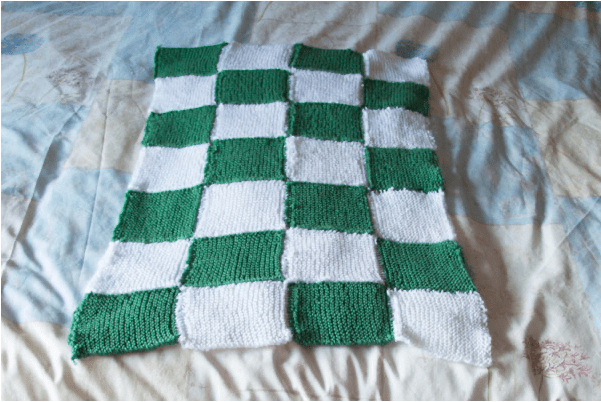
I had already taught her some basic garter stitches, and the next year she began making a patchwork blanket for her new niece or nephew, expected in May.
Knitting had helped her but, her anxiety got gradually worse, and our GP, Dr Keast, referred her for Cognitive Behavioural Therapy (CBT) which helps to resolve negative thinking patterns into a positive mindset. Although Zoë felt she was a failure asking for help, the therapist was kind and discussed the results of a score sheet she had filled in and diagnosed that she had General Anxiety Disorder (GAD). With a guided relaxation CD and a CBT Workbook to take away, there were weekly phone calls for the next six weeks. Through these, Zoë found that ‘setting goals could be a helpful way of improving my wellbeing’, she also discovered that her efforts to control anxiety were actually avoidance techniques to deal with the worries she had about her health. As a result, she was given a Health Anxiety Workbook which helped her explore her thoughts and actions and their affect on her anxiety, and from this she would always deal with new health problems by writing her own step by step process, e.g. of how she would get used to being in the outside world after shielding for four months.
However, knitting continued to be something Zoë turned to to be calm and mindful.
For further information on TSC-Associated Neuropsychiatric Disorders (TAND) visit https://tuberous-sclerosis.org/for-professionals/2022-tandem-seed-grant-award-round/
 Rare: A Journey of Self Acceptance by Zoë Bull