Two years since RARE was published

May 20th 2023

It is now two years since Zoë’s book, Rare – A Journey of Self-Acceptance, was published in which she described her life with Tuberous Sclerosis and LAM, and how she had come to accept having them.It is also two years since she died on April 5th 2021.

Much has happened for people with TSC since then with cannabidiol (Epidyolex) being available across the UK which can potentially reduce seizure frequency and severity. Zoë would certainly have appreciated this as her seizures were ever present and worried her very much.

Also, there is a campaign for access to a new cream for facial angiofibromas made from sirolimus which she took for her LAM. Zoë was always very conscious of her red lumpy facial rash which sirolimus had seemed to improve over the years, but she would have welcomed a topical cream for a more targeted treatment.

Something she would have been very pleased with is the new TSC Rare Disease Collaborative Network which will help to improve the knowledge and awareness of TSC in the NHS (which was one of the reasons why Zoë wrote her book in the first place); to standardise clinical and care pathways (often doctors in A&E would have to look up TSC because they didn’t know what it was); and lastly to give people with TSC a louder voice to engage with healthcare professionals, again reasons why she wrote her book.

Finally, there are the TSC training modules for social care and educational professionals, I may be biased, but I think they mirror a lot of the information Zoë wrote about in RARE. She would have been very proud.
The Shell and Facial Angiofibromas

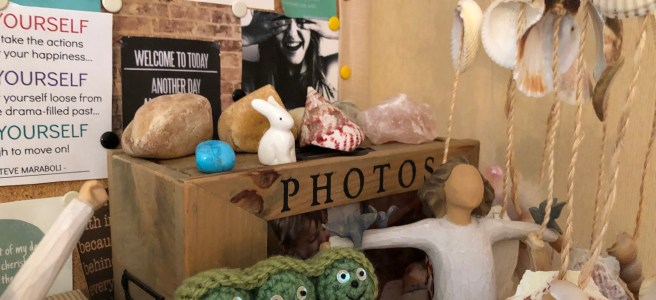
In her Introduction to RARE, Zoë describes how someone else chose the pink stripy shell she wanted, leaving her with the slightly imperfect one, and draws a parallel to her life with TSC. She wouldn’t have chosen it for herself, if she’d had the chance.

At a distance the shell looks lovely, but close up the pink stripes are covered with a deposit of calcium masking the stripes and making it difficult to see the pattern. In fact I found it difficult to take a close-up to show the beauty of the shell.

Zoë felt very conscious of her Facial Angiofibromas which of course showed up more the closer she looked in the mirror, and she felt that everyone else was aware of them too. I did try to reassure her that if people didn’t know about them, they probably wouldn’t notice them, or think they were just some other ordinary facial blemish but for her they were the most outward symptom of TSC that she had.

The good news now from the TSA is that several pharmaceutical companies are developing treatments for Facial Fibromas. and one of them is carrying out research to assess the impact of them on the lives of people who have TSC. There are at least three companies developing topical creams and the first treatment may be licensed for there UK as soon as next year. The latest details will be posted on the TSA website, social media and in the Scan magazine.

Facial Angiofibromas definitely affected Zoë’s self-confidence. It looks like others will not have to suffer so much in the future.

Coping with Facial Angiofibromas

July 13th 2010

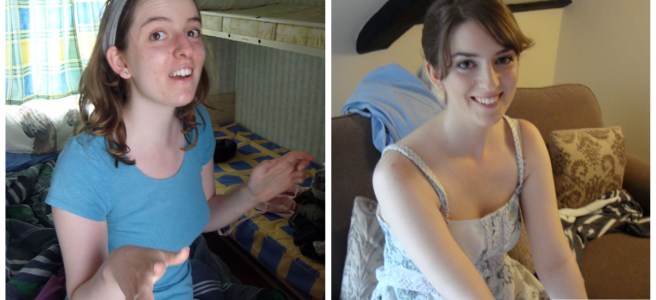
These photos of Zoë show her at seventeen and eighteen. In the first one on a Eurocamp holiday, she is happy and relaxed and doesn’t seem bothered by her Facial Angiofibromas. This is a far cry from the four-year-old Zoë who had the traumatic experience of having her face paint removed by an anxious campsite children’s courier who thought she was having an allergic reaction, and the schoolgirl Zoë who had to bear the unkind remarks of other children and, the discomfort of some laser treatment. As she got older, she tried to cover the raised red marks with foundation, but found that it just emphasised them, so concentrated on emphasising her good points: her eyes and her lovely smile instead.

In the second photo the following July, she has been made-up for her sister’s wedding. Although she looks happy here, she would much rather have not had that gloopy foundation drawing attention to her skin.

During the subsequent years, she began to give up make-up altogether, helped by the beneficial effects of the medication she was taking for LAM on her facial rash.

‘Without make-up I feel liberated and genuinely beautiful despite my ever-present flaws,’ she wrote in her book. And she was.

This was a significant step on her journey of self-acceptance.

Zoë’s Seizures Start Up Again at Disney World

April 2003

Here we are on that warm Florida evening, about to enjoy Spaghetti and meatballs at Tony’s Restaurant, just like Lady and the Tramp. But soon after this happy moment, as Zoë describes it in her book, ‘…a subtle warm fuzzy feeling came over me and I felt light-headed, the blood rushing to my legs. Was I fainting or dying? What was this?

She must have been so scared, but she didn’t say anything. And not expecting her to have a seizure, we didn’t notice, because we weren’t looking for them as we learnt to do in later years. By then, she knew that she had TS (if you look closely, you can see her facial angiofibromas) so perhaps she was worried that it may be a seizure, but didn’t want to tell us in case it was true. Also, at that time, she wouldn’t have been able to remember those seizures that she had as a baby, so wouldn’t have had anything to compare it with.

As she says, these ‘fuzzy feelings’ continued at school and sometimes, when she read to me at bedtime. We had no idea. We thought that she had grown out of the infantile seizures she’d had when she used to go stiff and tremble a bit for a few seconds. Therefore, two years later, it was a great shock when she had a more serious one whilst her friend, Izzy, was at our house. It was the one and only time that her eyes rolled upwards and she lost the ability to speak. It was truly scary. She seemed to be awake, but couldn’t talk.

“You were just looking at us like a frightened animal unable to say anything, but your eyes looked so scared,” I told her afterwards. It was like that. Like when you talk to a dog and they listen to you, but they can’t talk back. However, interestingly, I did try to get her to sing by singing Twinkle Twinkle Little Star to her and she could manage that, although I don’t know how much she understood about what she was doing.

We phoned the TS Clinic at Bath who were absolutely wonderful and gave us an appointment the next day. They put her on Tegretol (Carbamazepine) which eventually, after removing her favourite pineapple and grapefruit drink from her diet because the enzymes in them broke down the medication, controlled her seizures for four years. She was able to come off it in 2008, and, to her relief, be seizure-free and medication-free for a while.