
November 15th 2013
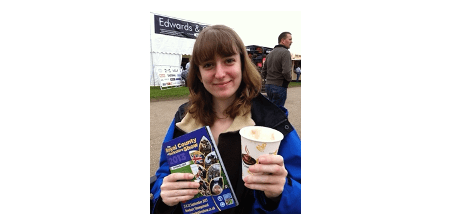
Here is the photo our neighbour, Betty, took of Zoë because she said she was looking so well after suffering a kidney bleed a few months before.
As Zoë reflected in RARE,
‘Looking at the photo, I can really see the colour in my cheeks, compared to the photo Mum and Dad took of me the day after my embolisation. I take that as a good sign that I’m looking and feeling better.‘

She had been through so much in those past three months: a terrible pain in her back had revealed itself, after blood tests and a CT scan, to be a kidney bleed resulting from the rupture of one of her renal angiomyolimpomas (AMLs). We were very grateful to Dr Amin at Bath who was able to liaise with the doctors at the Royal Berkshire Hospital, and advise them that an embolisation was the best course of action instead of removing the kidney because she may need it in the event of another renal AML on the other side.
The embolisation was done under sedation and a local anaesthetic, and took several hours. She had lost a lot of blood and needed a transfusion. However, even though she was sent home a couple of days later, her digestive system shut down, and her stomach swelled up so she had to go back into hospital to go on a drip to get things moving. All in all, she had lost three stone and had become anaemic, and it took several months before she was totally back to normal.
As she learnt later, these Renal AMLs were connected to LAM (Lymphangioleiomyomatosis) because of the increased levels of oestrogen as she entered her twenties, and this was to have a profound affect on her life.
 Rare: A Journey of Self Acceptance by Zoë Bull