Again, time has been passing so quickly, and it’s hard to believe that three years have passed since Zoë’s book was published.
She put so much into writing it and it is still helping those diagnosed with TSC and their families come to terms with the life-changing effects it can cause.
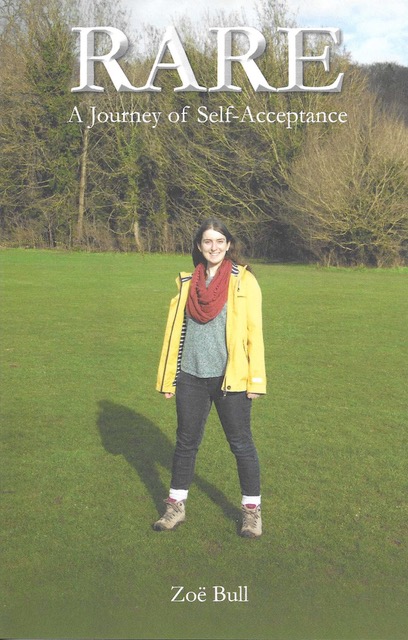
For those who haven’t read it yet, it is still available from Amazon, Waterstones, Blackwells and Hive.
It may also be interesting to watch the video that Zoë made for the TSA in April 2016 (again if you have already seen it!) where she talks about how she copes with TSC and her intention to write a book which, of course, she did.
This year’s popular event for those mildly affected by TSC will be in Leicester on Saturday, 22nd April. This year new attendees will be offered a ‘buddy’ who has attended before and can show them the ropes and introduce them to everyone.
Zoë was very nervous at her first meeting, as she says in RARE:
19th April 2015
When I arrived at the hotel, butterflies were starting to flutter in my stomach. I stepped into a small lounge area in the lobby where people were chatting away. Once I spotted a TSA staff member, she introduced me to a fashion degree student . . . He seemed mildly affected by TS too and I felt my insecurities about being accepted fall way. I spoke so freely to Tim and his mum and explained that I had never really spoken to anyone with TS before.
If you or your family are undecided about going, I’m sure that you find that you’ll meet people like you and can share your experiences.
At lunchtime I met some new faces, initiating conversations… ME? I felt fantastic and free. I spoke to another young woman who lived in West London, near where I went to university. We talked about our strengths and weaknesses at school concerning TS.
And, yes, Zoë is in this picture from before the Lockdown, right in the middle, surrounded by friends she’d made in the Outlook community.
As Zoë wrote in her book, 90% of TSC suffers can expect to develop mental problems, and anxiety is just one of them. It’s not surprising that it was such a big problem for her. Faced with first one, and then two, rare medical conditions, anyone would be come anxious about ‘upcoming appointments, medication or fears of becoming unwell’.
However, Zoë’s anxiety began, not worrying about her own health, but that of her dearly loved Granny, who after a heart attack, developed ovarian cancer.
She wrote in January 2010: Prior to this, I had never needed to prepare myself for losing a relative, but it caused more anxiety than I would have ever imagined. This led to her first panic attack which resulted in her worrying about having one again and created a vicious cycle of recovery, worry and anxiety.
In 2012, she began her photography degree course in London with its stressful course deadlines, and wrote:
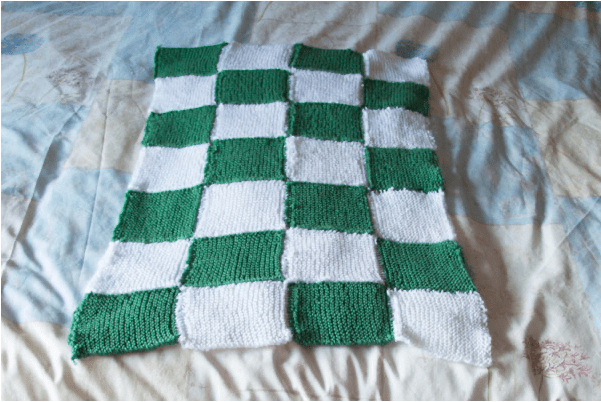
It was around this time when I began learning about mindfulness and how the worries we often have relate to what we have done in the past or what we are concerned about in the future. I was certainly worried something awful may happen to me in the future which I was trying to prevent that through worrying. By using mindfulness, I learnt that knitting is a great way to promote relaxation in the present moment while doing an activity.
Photo Zoë Bull 2013
I had already taught her some basic garter stitches, and the next year she began making a patchwork blanket for her new niece or nephew, expected in May.
Knitting had helped her but, her anxiety got gradually worse, and our GP, Dr Keast, referred her for Cognitive Behavioural Therapy (CBT) which helps to resolve negative thinking patterns into a positive mindset. Although Zoë felt she was a failure asking for help, the therapist was kind and discussed the results of a score sheet she had filled in and diagnosed that she had General Anxiety Disorder (GAD). With a guided relaxation CD and a CBT Workbook to take away, there were weekly phone calls for the next six weeks. Through these, Zoë found that ‘setting goals could be a helpful way of improving my wellbeing’, she also discovered that her efforts to control anxiety were actually avoidance techniques to deal with the worries she had about her health. As a result, she was given a Health Anxiety Workbook which helped her explore her thoughts and actions and their affect on her anxiety, and from this she would always deal with new health problems by writing her own step by step process, e.g. of how she would get used to being in the outside world after shielding for four months.
However, knitting continued to be something Zoë turned to to be calm and mindful.
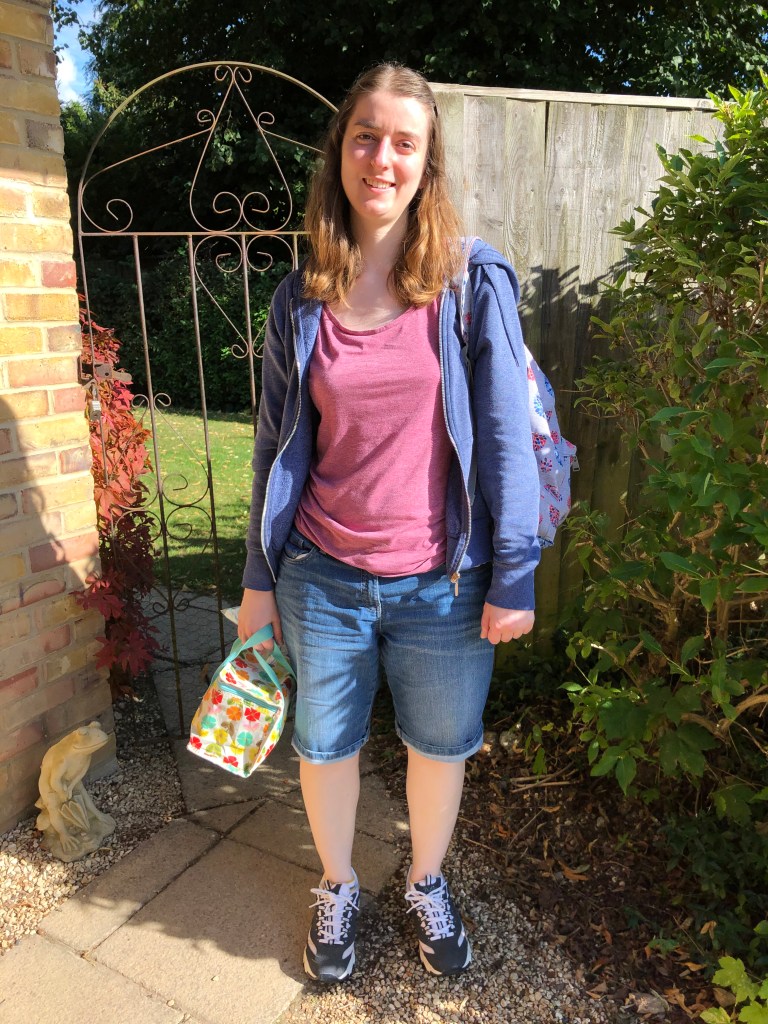
Zoë was so proud of her job as a Support Worker at Mencap, helping men and women with learning disabilities and empowering them to lead independent lives. This picture shows that even through Lockdown, when not only were the people she looked after shielding from COVID, she was as well, and although she couldn’t go in and be with ‘Callum’, the man she supported, she phoned him every Tuesday and Saturday afternoon to keep in touch. Here she is ready to make her call.
She was very keen to encourage all the people in the house to develop their independence, and do as much as they could unaided. One driving force behind this was the example set by her schoolfriend, Helen, who suffered from Cerebral Palsy, to achieve as much as she could, and of course, Zoë’s own determination to live her life as fully as possible.
In a letter to Mencap to explain why she couldn’t attend her second interview because of her lung collapsing, she wrote:
‘Paying attention to how the nurses work with the patients has inspired me even more to help others develop their independence.‘
She was offered the job, giving her a ‘small glow of happiness inside‘, and then returned to Guy’s to have a planned pleurodesis to stick her lung to her chest wall to prevent it collapsing again. But, due to complications, she was in hospital for most of May, and on writing to Mencap again, they offered put her application on hold without affecting her employment.
Zoë’ wrote: ‘Considering I had that horrible trial shift at that café back in March, the situation now couldn’t have been more different. I felt supported and respected; that my ill health was being taken seriously and Mencap were being patient enough to wait for me to fully recover before they were happy for me to start work.‘
This shows how supportive Mencap were, not only to their clients, but also to their staff, giving Zoë the opportunity to get that job and be proud of herself as a member of the working world.
As she said, ‘The experience has helped me become more accepting of people with TS, who may have learning disabilities too.’ And it helped her to reach that self-acceptance that she was striving so hard to find.
Since Zoë’s book was published last May, it’s been well received and read all around the world and has really helped people find out more about TSC and how Zoë lived her life with it.
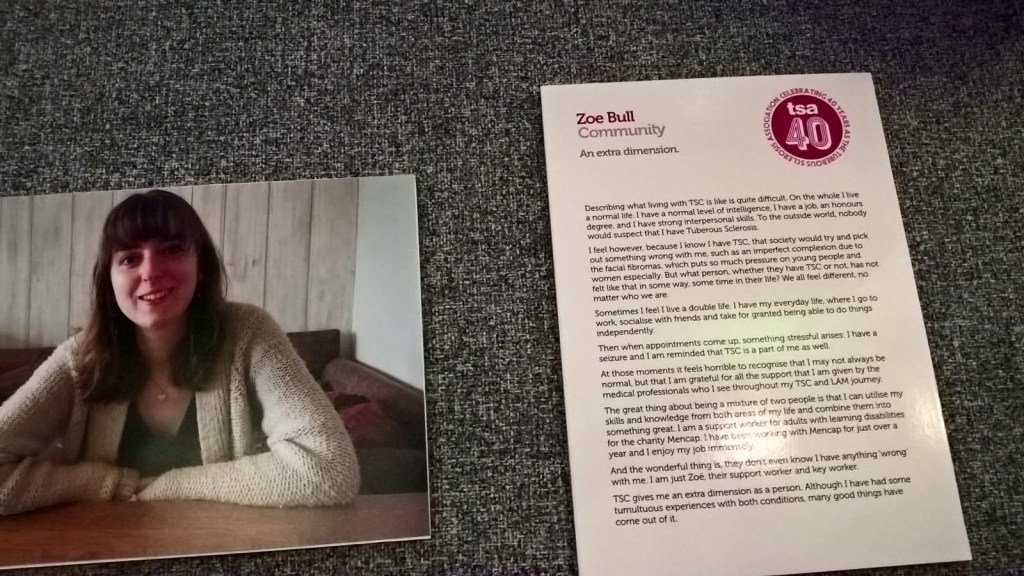
She always wanted to share her experiences and wrote several articles for the TSA Scan Magazine, and also a piece for the TSA 40th anniversary event at The Oxford Belfry in September 2017 which is shown above and a bit clearer here, below.
Zoë wrote about the difficulty of living with TSC when on the outside she appeared quite normal with a degree and a job, whilst inside, she was worried that society would try ‘to pick out something wrong with me’, like her imperfect complexion. She likened it to having a ‘double life’: the independent one of work and socialising, and the traumatic one of having TSC and clinic appointments. She said it felt horrible to to recognise that ‘I may not always be normal’, but she was grateful for all the medical support that she received.
However, she could see that this ‘double life’ meant that she could use all her skills and knowledge from both areas of her life and combine them into ‘something great’ in her work with Mencap. And she was so happy that they didn’t know there was anything wrong with her, she was ‘just Zoë, their support worker and key worker’.
Always optimist, she said that although TSC and LAM had resulted in some ‘tumultuous experiences’ for her, ‘many good things have come out of it’.
One of these things was the knowledge and experience that enabled her to sit down and write her book. The sad thing is that she never lived to see it published, although we edited it together and she chose the cover photos. I wish she could have seen it and held it in her hands. She would have been so very proud.
In July 2020, Zoë had finished writing her book, and to celebrate she found this flash card she used for counselling to pose for a picture. It says, ‘I feel a wave of enthusiasm for my achievements’, above a smiley face, and below that is says, ‘PROUD’.
She had put such a lot of hard work into writing it, not only revisiting her past and facing up to all the challenges she’d been through having Tuberous Sclerosis and LAM, but researching about those conditions to inform families and people affected by them, and the general public who probably had never heard of TS and LAM. We hadn’t until she developed them either . . .
On her way, she was supported by Dr Sam Amin who ran the Metformin trial at the Bath TSC clinic, which Zoë took part in. He kindly wrote the Foreword, and said:
‘I recall her positivity and determination not to be defined or limited by the condition which affected so many aspects of her life’ . . . ‘I cannot stress enough how important Zoë’s coping mechanisms have been in surmounting all the hurdles she has been faced with’ . . .’Zoë’s book has given me a deeper insight into TSC, from a different angle’.
Zoë also had the kind support from TSA CEO, Louise Fish, who read through the book before it was published, and Gill Hollis and Professor Anne Tattersfield who proof-read the sections on LAM.
Yes, she was so proud that she had got to the end, and we are very proud of her for writing it.
I can’t believe that it’s nearly six years ago since I drove Zoë to the Outlook event at the Oxford Belfry Hotel. She was feeling apprehensive about the day because it was to celebrate people with TS as it was the 20th anniversary of the Outlook group for mildly affected adults, and her TS was something she would normally be hiding away.
However, she was soon greeted by some original Outlook members who she’d met before and and other familiar faces that she knew. Feeling happier, she talked to a young woman and her mother. It was their first visit to an Outlook event and she reminded Zoë of herself a few years before, ‘awkward but excited’. Zoë also found out that she attended the same clinic at Bath, and had taken part in the same Metformin trials that she had.
After lunch, she felt nervous again because she was going to have a video interview with Tanya, the Volunteer Coordinator, who soon put her at her ease in a comfy leather chair which made her feel she was on Breakfast TV.
This is what she wrote in her book, Rare:
Everything I imagined saying, all those worries and negativity, went out the window. Instead I spoke about the confidence these events were giving me and how being a part of something has helped me feel less alone. As I was talking, I realised that I had been isolating myself by not accepting the advantages of being involved in a support group for such a rare condition. Why make myself more of an outcast than I need to?
It’s interesting to think, isn’t it, that as she was talking so confidently, all these thoughts were going through her head.
Zoë described what it was like to be mildly affected, and how she hoped that her experiences would help others. She added that, because of this, she found she could sympathise with the people she looked after, and the staff she worked with, in her role at Mencap. She said too, how attending the Outlook events had given her more confidence, and also how volunteering with the TSA had given her a chance to help others whilst putting her photography skills to good use. Lastly, she said that as she recovered from lung surgery in Guy’s Hospital, she decided to write a book to help people with TSA, and their parents, to understand more about the condition.
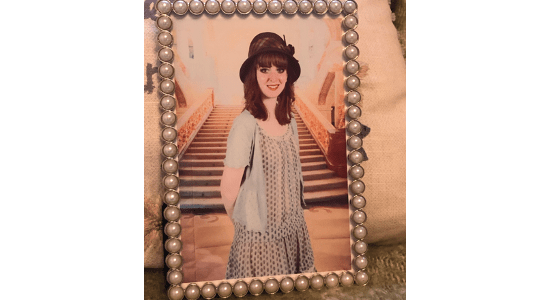
Zoë had been invited to take individual photos of everyone at the 1920’s Gala Evening to celebrate 20 years of Outlook, the special group for those mildly affected by TS. Again, she felt apprehensive, but was welcomed at the Oxford hotel, by a founder Outlook member she had met the year before. Another founder member talked about how Outlook had changed her life by giving her a positive outlook, and how she had learned to accept herself for who she was, which made Zoë reflect on how she had been learning to accept herself too.
She was pleased that her dad went along in the evening to help her set up the equipment and act as her assistant, and before she started her session, he took a photo of her in front of the grand staircase backdrop. Everyone was pleased with their photos which appeared in the Summer 2016 Scan Magazine with the comment that ‘A fun photoshoot by volunteerphotographer, Zoë Bull, added a spot of glamour to the proceedings’. She loved her own photo so much that she put it in a pretty pearl frame and kept it on her printer.
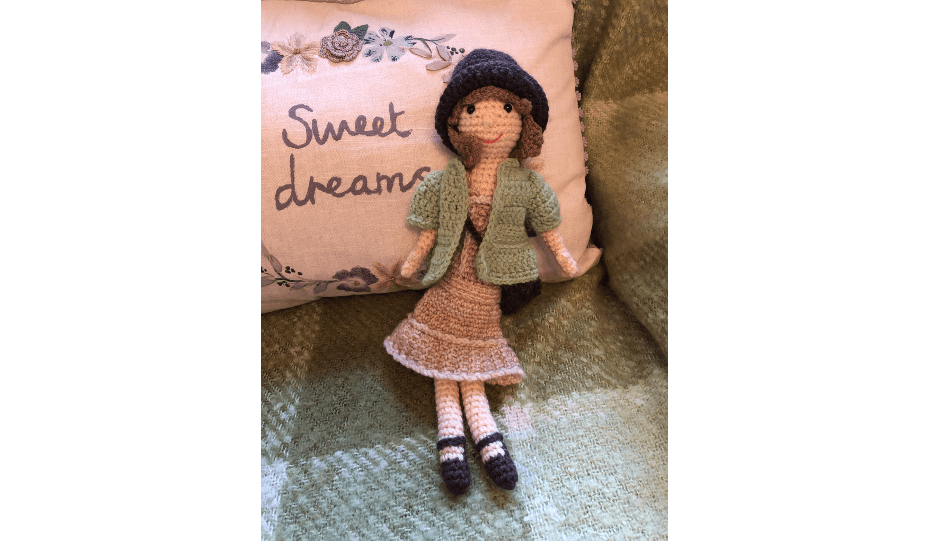
I was so proud of it that I showed it to my friend who had brought round some dolls she had crocheted. I asked her if she could possibly make a one like the picture for Zoë. It’s amazing that she did it just by taking a few photos as a guide.
Although I actually forgot to give it to Zoë on Christmas Day, she was really pleased when she opened it on Boxing Day. The only thing she wanted me to do was to embroider on a smile which I happily did. The 1920’s Gala Evening had been a great success for her and had helped her on her journey to self-acceptance.
In the last months of Zoë’s degree in Photography, she realised how much of her work was psychology related. She was beginning to be fascinated by the mind, and explored that in her coursework, images and essays. She couldn’t see herself as a business woman and saw herself more as someone who helped people with their problems. Her problem, though, was telling us! But we have always believed that our children should be encouraged to pursue what they wanted; not to be forced into anything, so she was surprised when we said it was all right not to become a photographer after all.
In 2014, just after her 21st birthday, she wrote her story of living with TS, and sent it in to Share Your Story on the TSA website. She wrote in her diary about how she hoped to use her normality to create a bridge between TS people and non-TS people. ‘I just hope it inspires’.
But the months went by with no response, and she considered becoming a TS volunteer instead. Perhaps she could make use of her photography skills there? Her first assignment was to take photos of all the staff on the TSA Staff Day to use in the TSA Scan Magazine. She wasn’t used to taking photos of new people, but when some said they didn’t usually like having their photos taken either, she realised that they had their insecurities too, and she felt better.
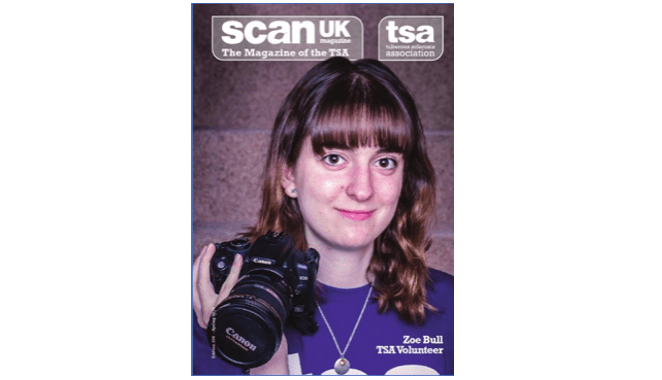
After several months coping with her first lung collapse, she was cheered by being asked to do a telephone interview about her story by Isobel, the TSA magazine editor, who also requested a photo of her for the front of the magazine!
Here it is. Her journey as a TSA Volunteer photographer had begun!
This year the TSA Virtual Outlook Festive Special for mildly affected adults with TSC is on Saturday, 11th December from 3.00 to 5.15. For further details, follow this link https://tuberous-sclerosis.org/event/outlook-festive-2021/ Don’t forget your Christmas jumper!
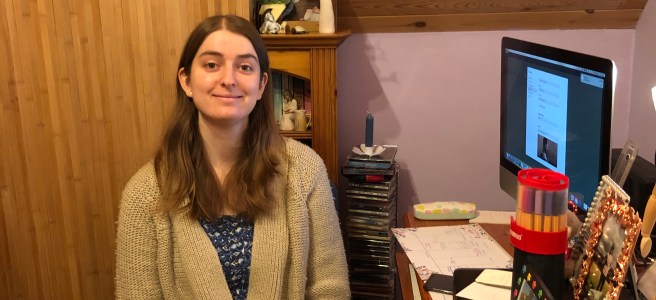
Zoë used to love Christmas and mentions it several times in her book, she also grew to love the Outlook events and I’m sure she would be writing some questions for this year’s quiz. The photo above is of her last year, sitting by her desk where she used to sit when she joined in the Outlook quizzes on a Saturday afternoon.
In her Introduction to RARE, Zoë describes how someone else chose the pink stripy shell she wanted, leaving her with the slightly imperfect one, and draws a parallel to her life with TSC. She wouldn’t have chosen it for herself, if she’d had the chance.
At a distance the shell looks lovely, but close up the pink stripes are covered with a deposit of calcium masking the stripes and making it difficult to see the pattern. In fact I found it difficult to take a close-up to show the beauty of the shell.
Zoë felt very conscious of her Facial Angiofibromas which of course showed up more the closer she looked in the mirror, and she felt that everyone else was aware of them too. I did try to reassure her that if people didn’t know about them, they probably wouldn’t notice them, or think they were just some other ordinary facial blemish but for her they were the most outward symptom of TSC that she had.
The good news now from the TSA is that several pharmaceutical companies are developing treatments for Facial Fibromas. and one of them is carrying out research to assess the impact of them on the lives of people who have TSC. There are at least three companies developing topical creams and the first treatment may be licensed for there UK as soon as next year. The latest details will be posted on the TSA website, social media and in the Scan magazine.
Facial Angiofibromas definitely affected Zoë’s self-confidence. It looks like others will not have to suffer so much in the future.
Here is the photo our neighbour, Betty, took of Zoë because she said she was looking so well after suffering a kidney bleed a few months before.
As Zoë reflected in RARE,
‘Looking at the photo, I can really see the colour in my cheeks, compared to the photo Mum and Dad took of me the day after my embolisation. I take that as a good sign that I’m looking and feeling better.‘
August 13th 2013
She had been through so much in those past three months: a terrible pain in her back had revealed itself, after blood tests and a CT scan, to be a kidney bleed resulting from the rupture of one of her renal angiomyolimpomas (AMLs). We were very grateful to Dr Amin at Bath who was able to liaise with the doctors at the Royal Berkshire Hospital, and advise them that an embolisation was the best course of action instead of removing the kidney because she may need it in the event of another renal AML on the other side.
The embolisation was done under sedation and a local anaesthetic, and took several hours. She had lost a lot of blood and needed a transfusion. However, even though she was sent home a couple of days later, her digestive system shut down, and her stomach swelled up so she had to go back into hospital to go on a drip to get things moving. All in all, she had lost three stone and had become anaemic, and it took several months before she was totally back to normal.
As she learnt later, these Renal AMLs were connected to LAM (Lymphangioleiomyomatosis) because of the increased levels of oestrogen as she entered her twenties, and this was to have a profound affect on her life.
A big thank you to Julie Huntingdon and her team of helpers who held a coffee morning at the Whitchurch Art Café and raised £297 for the TSA, plus the sales of Zoë’s book which raised £60, split between the TSA and LAM Action as she had wished. A reporter even visited and it appeared in the local paper, resulting in even more book sales.
Thank you too, to our local community who got behind this effort and made it such a success.
In August 2013, at the age of 20, Zoë suffered a kidney bleed, but there was no obvious bleeding, just a terrible pain in her side. We had no idea it was so serious and took her to an osteopath who sent us off to A&E where Zoë was assessed. She had a CT scan which showed her right kidney was bleeding internally. It was lucky we were there, because the normal procedure would be to remove the kidney but, for TSC patients, embolisation is recommended to preserve what’s left of it in case there is another bleed on the other side. We were able to contact Dr Amin at Bath who liaised with the doctors about what was to be done in Zoë’s case.
Although the embolisation was successful and she was sent home, Zoë’s digestive system shut down with the shock, and she became very bloated and uncomfortable, so she had to go back into the Royal Berks for several days to go on a drip until that was put right.
She had lost 3 stone, and her haemoglobin was very low, so she was given some iron tablets and told to eat lots of calorific snacks, something that she had avoided to keep healthy!
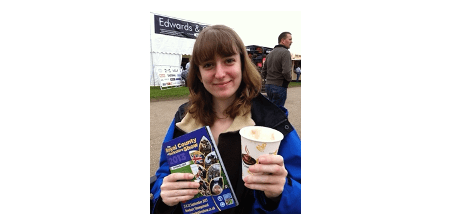
The photo above shows her at the Newbury Show five weeks later. Nothing was going to stop her going on her favourite annual day out, and you can just see that she is sitting in a wheelchair. She had been through such a lot.
It wasn’t until 2014, when she was diagnosed with LAM, that we became aware of the connection between kidney bleeds, oestrogen and LAM: her hormones had kicked in at the start of childbearing age, resulting in the bleed.
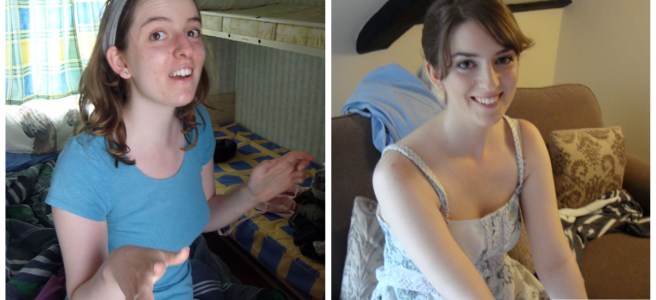
These photos of Zoë show her at seventeen and eighteen. In the first one on a Eurocamp holiday, she is happy and relaxed and doesn’t seem bothered by her Facial Angiofibromas. This is a far cry from the four-year-old Zoë who had the traumatic experience of having her face paint removed by an anxious campsite children’s courier who thought she was having an allergic reaction, and the schoolgirl Zoë who had to bear the unkind remarks of other children and, the discomfort of some laser treatment. As she got older, she tried to cover the raised red marks with foundation, but found that it just emphasised them, so concentrated on emphasising her good points: her eyes and her lovely smile instead.
In the second photo the following July, she has been made-up for her sister’s wedding. Although she looks happy here, she would much rather have not had that gloopy foundation drawing attention to her skin.
During the subsequent years, she began to give up make-up altogether, helped by the beneficial effects of the medication she was taking for LAM on her facial rash.
‘Without make-up I feel liberated and genuinely beautiful despite my ever-present flaws,’ she wrote in her book. And she was.
This was a significant step on her journey of self-acceptance.
Here are the two photos Zoë talks about when she is twenty-six. Anyone else would just see a cute little girl in a ballet costume, or one peeping from behind a toy car, but she sees only that she has a clear face with smooth skin. She says she ‘felt pretty and free’.
Zoë’s toddler and pre-school days were carefree for us all. Her epilepsy seemed to have stopped. However, one morning soon after her diagnosis with TS, our Health Visitor phoned. I had just got back from shopping and I had popped a sleepy Zoë in her cot whilst I put things away. The Health Visitor was only phoning to help me; she’d found some information about Tuberous Sclerosis. But I couldn’t bear it as she read through the list of all the organs of the body that can be affected, as I shoved the food in the cupboards . I couldn’t believe it. All this could not be going to happen to my beautiful little daughter who was sleeping so peacefully in her room.
The months and years went on. She enjoyed toddlers. She went to a wonderful childminder who encouraged her with arts, craft, stories and singing. She started pre-school and made lots of friends and they all went to ballet and swimming together. It wasn’t until 1998 that she started school and things gradually began to change.
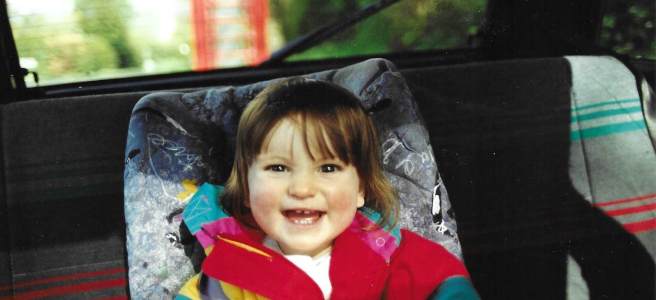
Zoë was a happy healthy baby until a trip to Somerset at Easter when her brother and sister noticed her stiffening up and staring as they sat with her in the back of the car. Afterwards, it always seemed that she had these strange seizures in her car seat. We wondered if it was the metal frame of the seat causing a kind of Faraday effect, so we borrowed a polystryene one (not allowed in 2021!) and that seemed to help. However, she began to have seizures in her buggy too.
It was difficult for our GP, Dr Keast, to say what was causing them at first, as she never had them when I took her to see him. The next week, I took in a video of her so all the doctors could have a look at their break time. Still no answers.
One day, whilst out shopping in the buggy, she began to stiffen and stare, so I took her straight round to the surgery. The doctor on duty thought she might have meningitis and called an ambulance (the first of many) so she could be taken to hospital for a lumbar puncture. I wasn’t allowed in and it was terrifying to hear her screams as I stood and looked out of the window.
It wasn’t meningitis, but she was kept in overnight and I was allowed to stay. My husband, Gordon, brought in some pizzas and we shared them with another family whose little girl, Zoë’s age, had cerebral palsy. As good fortune would have it, we met up at a mutual friend’s house, and Helen became a very good friend of Zoë’s, especially at secondary school.
On visiting Dr Keast again, to discuss our hospital visit, I mentioned that Zoë had a mysterious white patch on her leg. ‘Ah,’ he said, ‘Seizures and white patches. That sounds like she has Tuberous Sclerosis.’
Zoë first met Jane at the Outlook meetings and joined her in the online Saturday Pub Quizzes during lockdown.
My name is Jane Rogers nee Kelshaw. I am 46 years of age. I’m married to Phil who doesn’t have TS. I have a brother called John who does not have TS and his two boys don’t have TS. I am a nurse at my local hospital, part time on the stroke ward.
I was 18 months old when I was diagnosed with TS. They saw under ultraviolet light the white patches and I was having seizures. I didn’t speak till I was 5. Over the years I’ve felt the full run of emotions happy, sad, angry, now acceptance/tolerance. I have met amazing health professionals and fellow TS sufferers/carers that I wouldn’t otherwise have known.
TSC for me. I have had numerous kidney bleeds and embolisations over the years. I’ve had laser treatment for the facial rash when I was 12. I was advised not to have children. We have a dog called Tessa.
I have been a member of Outlook (a group for mildly affected adults with TSC) since the beginning, and Outlook has meant so much; I feel I can be myself as we’re all like one big family.
My advice to newly diagnosed people would be don’t panic! It’s a challenge. Remember that there are other people out there with TSC. You may think you are all alone but you’re not. There are people at TSA that can point you in the right direction for help/support.









 Rare: A Journey of Self Acceptance by Zoë Bull